
Those are valid concerns, but they miss the more important question for security teams:
What actually happens when an identity system is compromised?
Incidents like this aren’t just about data loss. They’re about control.
Identity Systems Change the Blast Radius
In most environments, identity systems sit at the center of everything. They control authentication, access to internal systems, third-party integrations, and the trust relationships that tie environments together.
When a typical system is compromised, the impact is often contained.
When an identity system is compromised, that containment disappears quickly.
Because identity isn’t just another system, it’s the layer everything else depends on.
Most Attacks Still Start the Same Way
Even in incidents involving critical infrastructure like digital identity platforms, the initial access point is rarely exotic.
Attackers usually start with something familiar, compromised credentials, phishing, misconfigured services, or vulnerabilities in internet-facing systems. At that stage, access is often limited.
What matters is what that access allows them to do next.
Privilege Escalation Inside Identity Systems
Once attackers gain a foothold, the next step is almost always increasing control over identity.
In a traditional environment, that might mean escalating to domain administrator. In an identity platform, it can mean gaining control over authentication services, identity records, or token issuance.
At that point, the attacker isn’t just inside a system. They’re operating at the level where trust is defined.
That’s what turns a limited intrusion into something much more serious.
From Identity to Full Environment Access
When identity is compromised, attackers don’t need to break into every system individually. Access is effectively granted to them.
What we typically see is a progression that starts with initial access, moves into privilege escalation within the identity system, and then expands outward through trusted authentication flows. From there, attackers can access downstream systems, impersonate users, and operate across the environment without needing traditional lateral movement techniques.
This is why identity system breaches escalate so quickly. Once trust is compromised, access follows.
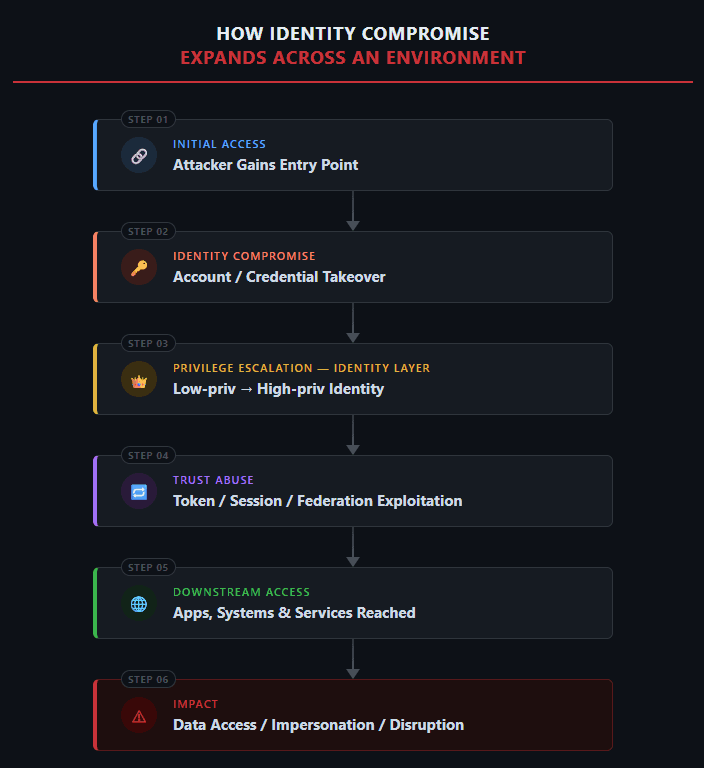
Why These Incidents Scale So Quickly
The speed and impact of incidents like this come down to centralized trust.
When authentication is centralized, a single compromise can affect multiple systems at once. Access propagates through legitimate channels, making attacker activity harder to distinguish from normal behavior.
From the outside, it looks like a sudden large-scale breach.
In reality, it’s often a small foothold that expanded once identity control was established.
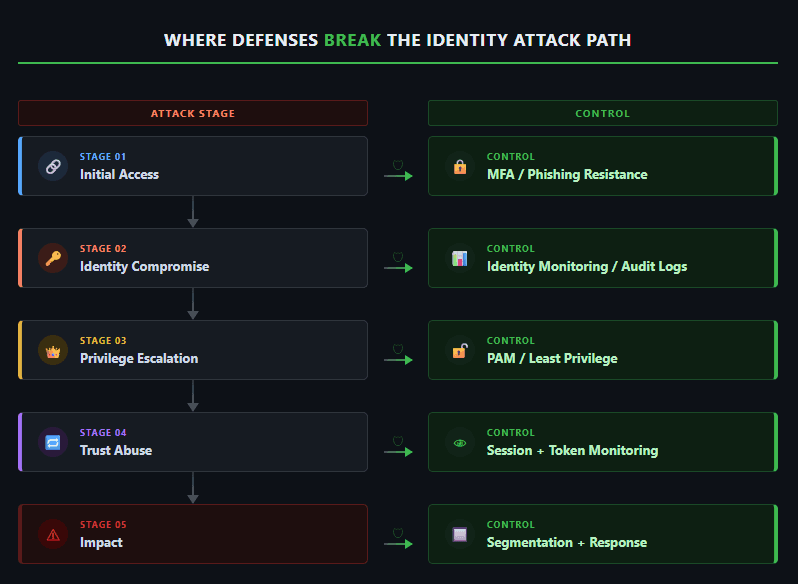
Breaking the Attack Path
Like any intrusion, there are points where this progression can be interrupted.
Controls around initial access, such as MFA and phishing resistance, reduce the likelihood of a foothold. Strong privilege management and monitoring of administrative activity help limit escalation within identity systems. Detection around authentication behavior and session activity can surface abuse of trust relationships. And segmentation, monitoring, and response readiness reduce downstream impact.
The objective is limiting how far a compromise can spread once identity is involved.
The Real Takeaway
Incidents like this reinforce a consistent pattern.
Initial access is usually straightforward. Privilege escalation determines the impact. Control over identity determines how far an attacker can go.
Identity systems aren’t just another asset, they define how access is granted across the environment.
When they are compromised, attackers don’t just gain access, they inherit trust.
For organizations watching incidents like this unfold, the important question isn’t whether a similar attack could happen.
It’s whether your current controls would stop it from progressing.