
While those details matter, they can sometimes obscure a more useful question for security teams: How do attacks like this actually unfold inside an environment?
Many high-profile cyber incidents follow a familiar technical pattern. Understanding that pattern helps organizations focus on the controls that actually prevent small intrusions from becoming major disruptions.
Most Attacks Begin With Limited Access
Contrary to what many headlines suggest, attackers rarely begin with full control of a system.
Instead, they typically gain a foothold through something relatively ordinary:
exposed services
weak or reused credentials
phishing attacks
misconfigurations
vulnerabilities in internet-facing systems
At this stage, the attacker’s access is usually limited, and the compromised system may not be particularly valuable on its own.
What matters is what the attacker can reach from there.
Privilege Escalation Changes Everything
Privilege escalation is often the point where an intrusion becomes significantly more dangerous.
Once attackers move from limited access to administrative or privileged control, their capabilities expand dramatically.
They may be able to:
access additional systems
modify configurations
extract sensitive information
disable monitoring tools
disrupt operations
This is why privilege escalation weaknesses frequently appear in major cyber incidents. The initial access point may be relatively minor, but elevated privileges allow attackers to move deeper into the environment.
Attackers Build Paths Through Environments
Another common pattern in incidents like this is the chaining together of multiple smaller weaknesses.
Attackers rarely rely on a single vulnerability. Instead, they build attack paths.
A typical sequence might look like this:
Initial access through an exposed service or compromised credential
Privilege escalation on the compromised system
Lateral movement to other machines or services
Access to higher-value infrastructure
Individually, some of these issues might not appear critical. Combined, they create a path that allows attackers to move through an organization’s environment.
This is why security teams often focus not just on individual vulnerabilities, but on how weaknesses can be combined.
Based on currently reported information, the Handala incident appears to follow a typical escalation pattern seen in many major breaches.
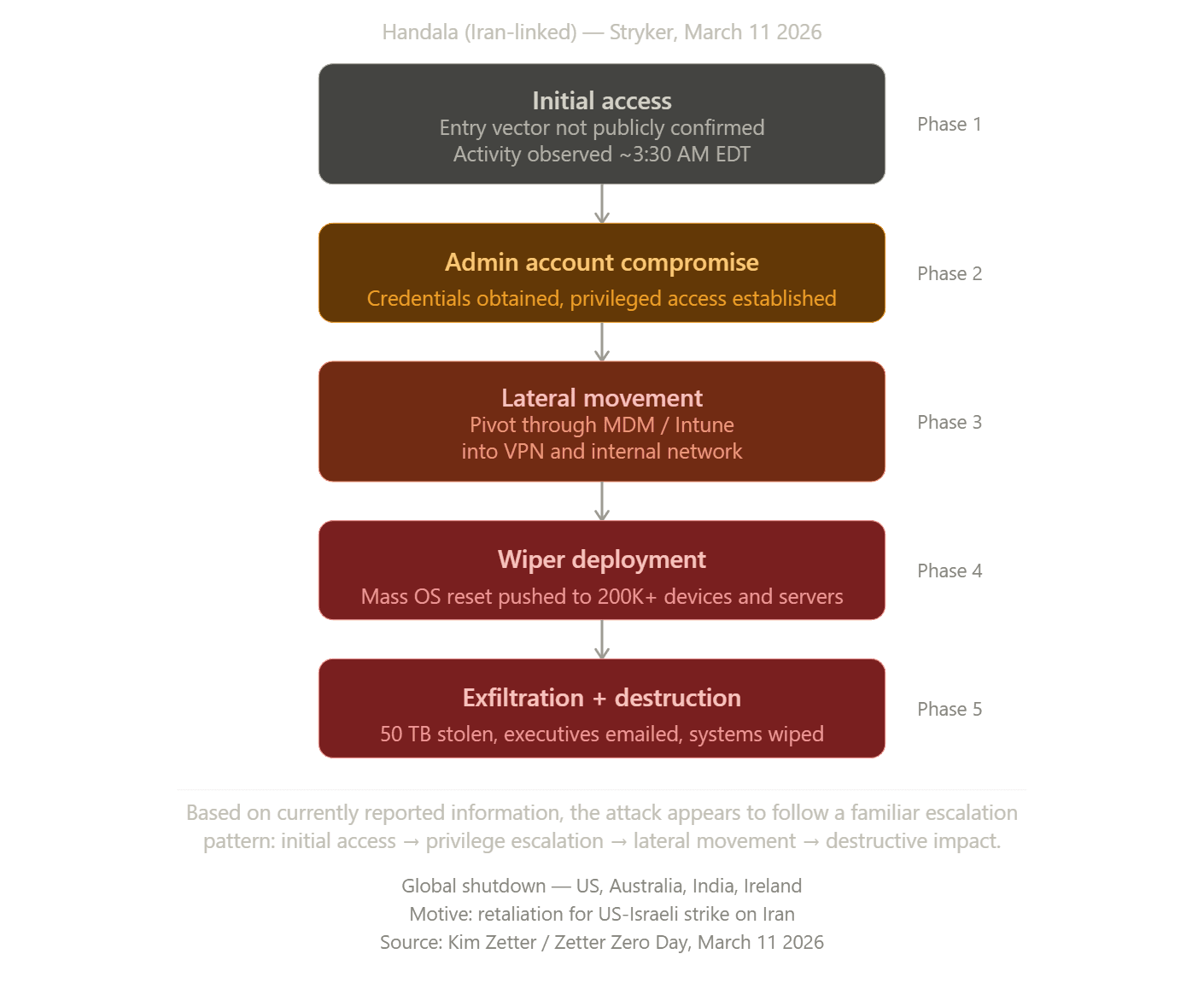
What makes incidents like this dangerous is not the initial breach, but how quickly attackers can escalate privileges and move through an environment once they gain a foothold.
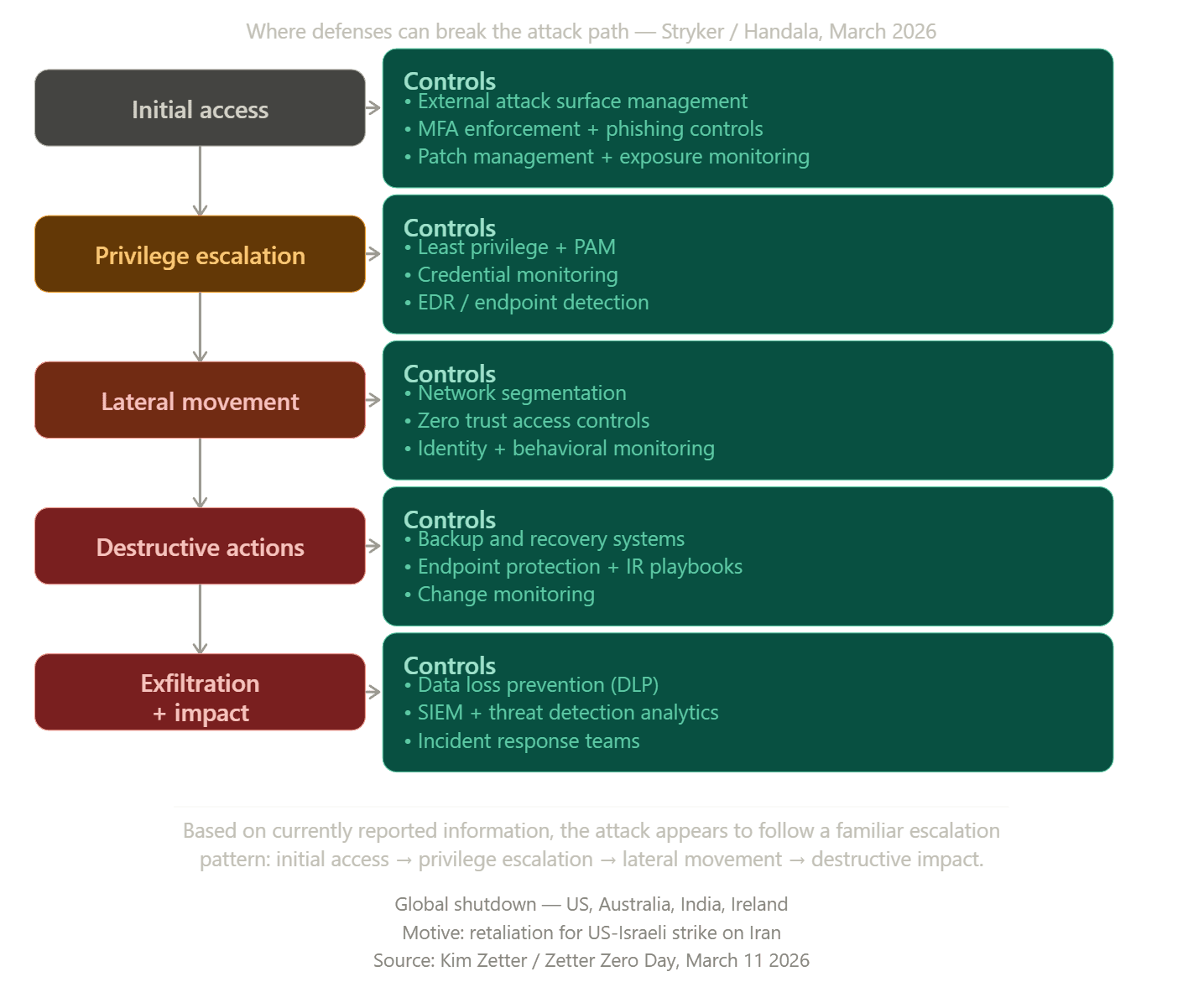
Incidents like this rarely succeed because of a single vulnerability. They succeed when attackers are able to move through multiple stages without being detected or stopped. The good news is that defenders have opportunities to break this chain at several points.
Why This Matters for Healthcare and Medical Device Environments
Healthcare and medical device environments are particularly complex from a security perspective.
They often include a mix of:
clinical systems
connected medical devices
identity platforms
vendor-managed infrastructure
operational technology
Because of this complexity, attackers often do not target devices directly. Instead, they may compromise surrounding systems and move laterally toward more sensitive infrastructure.
Understanding how attackers navigate environments is essential for preventing those paths from forming.
The Real Takeaway
High-profile cyber incidents often look sophisticated from the outside. In reality, many follow a familiar pattern: initial access, privilege escalation, and lateral movement. When those stages occur without detection, a small intrusion can quickly become a major disruption.
Strengthening controls around identity, privilege management, monitoring, and security testing can significantly reduce the likelihood that a small foothold becomes a larger incident.
For organizations reviewing the latest headlines, the most productive response is not panic. It is making sure the fundamentals of security are working as intended.
In environments that include connected medical devices or operational technology, understanding and limiting privilege escalation paths becomes especially important.